Maria hasn’t been in a car accident in three years. But every time brakes squeal nearby, her stomach drops before her mind even catches up. She doesn’t call it PTSD. She calls it “just being careful.” James left the military over a decade ago. He doesn’t have flashbacks, doesn’t talk about combat. He just can’t sit with his back to a restaurant door, snaps at his kids more than he’d like, and hasn’t slept through the night in years. Neither of them fits the picture most people have in their heads. And that’s exactly the problem because what PTSD really looks like rarely matches the movies.
The Gap Between the Stereotype and Reality
Popular media has trained most of us to expect PTSD to look dramatic: a soldier diving for cover at a car backfiring, someone frozen mid-scream during a flashback. Those moments happen, but they’re far from the whole picture. For many people, what PTSD really looks like is quieter, subtler, and easy to mistake for a personality trait being “just anxious,” “just irritable,” or “just a control freak.”
This gap matters. When people don’t recognize their own experience in the stereotype, they often go years without connecting their symptoms to trauma at all.
PTSD Doesn’t Require a Single Dramatic Event

One common misconception is that PTSD only develops after combat, assault, or a single catastrophic event. In reality, what PTSD really looks like can stem from:
- A serious car accident or medical emergency
- Childhood neglect or abuse
- Witnessing violence, even without being directly harmed
- Prolonged emotional abuse in a relationship
- A frightening medical diagnosis or traumatic birth experience
- Sudden loss of a loved one
Repeated or prolonged trauma especially in childhood can lead to a related but distinct condition called complex PTSD, which often includes deeper struggles with identity, trust, and emotional regulation.
So, What Does PTSD Really Look Like?
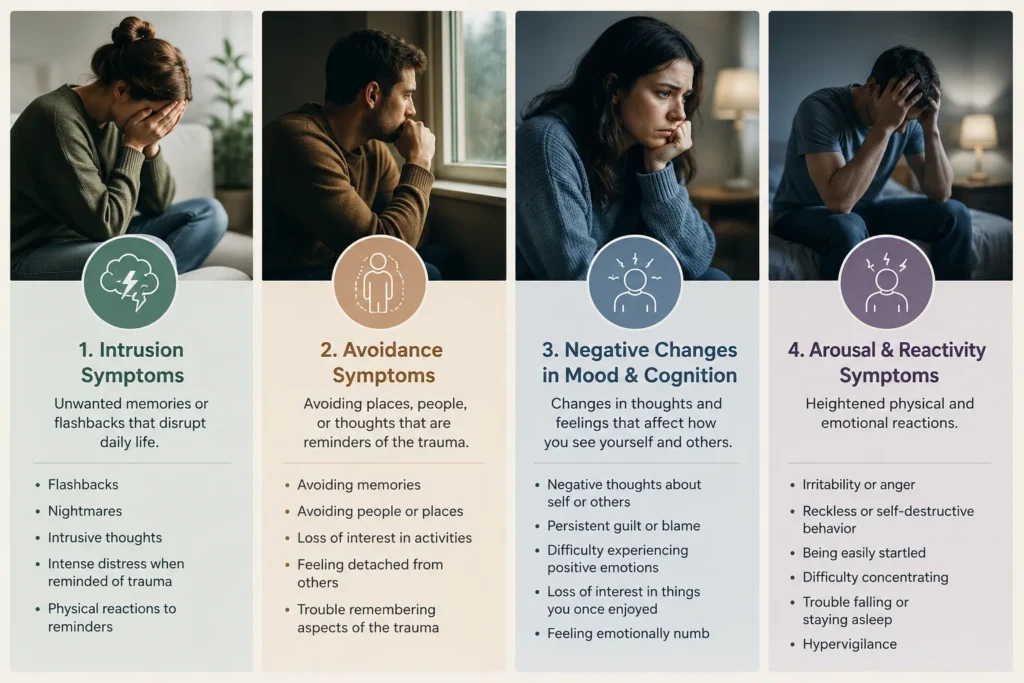
Beyond flashbacks, what PTSD really looks like typically falls into four core symptom clusters.
1. Re-Experiencing
- Intrusive memories that surface without warning
- Nightmares related to the traumatic event
- Intense physical or emotional reactions to reminders a smell, sound, or place
- Feeling as though the event is happening again, even briefly
2. Avoidance
- Steering clear of people, places, or conversations connected to the trauma
- Avoiding thoughts or feelings related to what happened
- Staying constantly busy to avoid sitting with difficult emotions
3. Negative Changes in Thinking and Mood
- Persistent guilt, shame, or self-blame
- Feeling emotionally numb or disconnected from others
- Loss of interest in activities once enjoyed
- Difficulty remembering key parts of the traumatic event
4. Hyperarousal
- Feeling constantly on edge or easily startled
- Difficulty sleeping or staying asleep
- Irritability or sudden anger outbursts
- Trouble concentrating
Quick Tip: If you notice a consistent pattern across these four categories that traces back to a specific experience even one that happened years ago that pattern is worth discussing with a professional, regardless of how “minor” the original event may seem in hindsight.
What High Functioning PTSD Can Look Like
Not everyone with PTSD struggles visibly. Many people build careers, families, and full lives while privately managing significant symptoms. What PTSD really looks like in these cases might include:
- Excelling at work while feeling emotionally shut down at home
- Being the “reliable one” while quietly avoiding vulnerability
- Managing hypervigilance through control over schedules, environments, or relationships
- Explaining away irritability or exhaustion as “just stress” or “just my personality”
Did You Know? Research indicates that trauma exposure is common across the general population, yet only a subset of people who experience trauma go on to develop PTSD meaning individual risk factors, support systems, and biology all play a role in who develops lasting symptoms.
Myth vs. Fact
Myth: “PTSD only affects veterans or survivors of violent crime.” Fact: What PTSD really looks like spans a much wider range of experiences, including car accidents, medical trauma, childhood adversity, and relationship abuse.
Myth: “If you can hold down a job and a family, you don’t really have PTSD.” Fact: High-functioning PTSD is real and common. Outward success often coexists with significant internal struggle, especially when someone has become skilled at masking symptoms.
PTSD vs. Complex PTSD
| Feature | PTSD | Complex PTSD (C-PTSD) |
|---|---|---|
| Typical cause | Single traumatic event | Repeated or prolonged trauma |
| Core symptoms | Re-experiencing, avoidance, hyperarousal | Above symptoms plus identity and self-worth struggles |
| Emotional regulation | Can be significantly affected | Often more persistently affected |
| Relationships | Trust and intimacy can be impacted | Trust and attachment often deeply affected |
| Treatment | Trauma-focused therapy, medication | Longer-term trauma-informed therapy, medication |
How PTSD Affects Relationships
Trauma doesn’t stay contained to the person who experienced it, it ripples outward. What PTSD really looks like in relationships often includes:
- Difficulty trusting a partner, even one who’s never given reason for doubt
- Emotional distance or numbness that feels like disinterest, but isn’t
- Sudden irritability that seems disproportionate to the moment
- Avoiding vulnerability or deep conversations
- Startling easily or needing control over the environment to feel safe
Warning Sign Box: If trauma-related distress includes thoughts of self-harm or suicide, this is a medical emergency. Call or text 988 (Suicide & Crisis Lifeline) or go to the nearest emergency room immediately.
When Should You Seek Help?
Consider reaching out to a professional if:

- Symptoms have persisted for more than a month after a distressing event
- You’re avoiding people, places, or situations that remind you of what happened
- Sleep, concentration, or mood have been consistently affected
- Loved ones have noticed changes in your reactions or behavior
- You feel disconnected from yourself or others more often than not
Expert Advice: A trauma-informed psychiatric evaluation looks at your full history, not just a single event, to understand the complete picture of what PTSD really looks like in your specific life.
Treatment Options for PTSD
Effective, evidence-based treatment can significantly change what PTSD really looks like for someone over time. Common approaches include:
- Psychiatric evaluation: a trauma-informed assessment to guide accurate diagnosis and treatment planning
- Trauma-focused therapy: including approaches like EMDR and trauma-focused cognitive behavioral therapy
- Medication management: certain medications can reduce hyperarousal, intrusive symptoms, and mood disturbances
- Genetic testing (GeneSight®): helps identify which medications may work best for your body
- Group therapy: connecting with others who understand trauma-related struggles
- Individual therapy: a consistent space to process trauma safely, at your own pace
What Recovery From PTSD Really Looks Like

Recovery rarely means forgetting what happened. More often, it means the traumatic memory stops running the show triggers lose their grip, sleep steadies, relationships feel safer, and the nervous system slowly learns that danger has passed. What PTSD really looks like in recovery isn’t the absence of the past. It’s the ability to carry it without being controlled by it.
How A New Hope Psychiatric Services Helps
At A New Hope Psychiatric Services, we understand that trauma rarely announces itself the way people expect. Our team provides compassionate, trauma-informed care for adolescents and adults across Florida, offering psychiatric evaluations, medication management, individual and group therapy, and personalized treatment plans built around your actual history not assumptions about what trauma “should” look like.
We offer:
- Telehealth appointments available throughout Florida
- In-person appointments at our Clermont, Florida office
- Both insurance and self-pay options
- Providers and therapists currently accepting new patients
If your experience doesn’t match the stereotype, that doesn’t mean it isn’t PTSD. It means it’s time to talk to someone who understands the full range of what PTSD really looks like.
Frequently Asked Questions
PTSD often includes hypervigilance, emotional numbness, avoidance behaviors, irritability, and sleep disturbances, in addition to or instead of dramatic flashbacks.
Yes. Car accidents, medical trauma, childhood adversity, sudden loss, and relationship abuse can all lead to PTSD.
It refers to someone who manages significant PTSD symptoms while still maintaining outward success at work or in relationships, often through masking or compensation.
PTSD typically follows a single traumatic event, while complex PTSD stems from repeated or prolonged trauma and often includes deeper struggles with identity and trust.
Yes, though symptoms often begin within the first few months, delayed-onset PTSD can surface later, sometimes triggered by an unrelated stressor.
PTSD can create difficulty with trust, emotional closeness, and communication, often showing up as distance, irritability, or a need for control.
It’s a heightened state of alertness where a person constantly scans their environment for potential danger, even in safe settings.
Yes. Irritability and anger outbursts are common hyperarousal symptoms of PTSD, not just fear-based reactions.
Through a trauma-informed psychiatric evaluation that reviews trauma history, current symptoms, and their impact on daily functioning.
Trauma-focused therapy (such as EMDR), medication management, and individual or group therapy are among the most effective evidence-based treatments.
For many people, yes. Certain medications can reduce hyperarousal, intrusive thoughts, and mood symptoms, especially alongside therapy.
EMDR (Eye Movement Desensitization and Reprocessing) is a trauma-focused therapy that helps the brain process traumatic memories more adaptively.
Yes. Children can develop PTSD after trauma, though symptoms may look different than in adults, such as regressive behaviors or reenacting the event in play.
Concentration difficulties, hypervigilance, and emotional exhaustion related to PTSD can affect focus, decision-making, and workplace relationships.
It refers to a reduced ability to feel positive emotions or connect with others, often as the mind’s way of protecting itself from overwhelming feelings.
Many insurance plans cover psychiatric evaluations and trauma-focused treatment; A New Hope accepts both insurance and self-pay patients.
Yes, telehealth psychiatry and therapy are available throughout Florida for PTSD evaluation and treatment.
Through trauma-informed psychiatric evaluations, medication management, and individual and group therapy, available via telehealth or in-person in Clermont.
Recovery typically means reduced symptom intensity, restored sleep and relationships, and the ability to recall the trauma without being overwhelmed by it not necessarily forgetting it.
Yes, our therapists and psychiatric providers are currently accepting new patients for both telehealth and in-person appointments in Clermont, Florida.