

Booking your first therapy appointment can bring up a strange mix of relief and nerves relief that you’re finally taking a step toward feeling better, and nerves about walking into a room (or logging into a video call) and talking to a stranger about your inner world. That uncertainty is completely normal. Knowing what to expect from individual therapy can make that first step feel a lot less intimidating.
What Is Individual Therapy, Exactly?
Individual therapy is one-on-one counseling between you and a licensed mental health professional, focused entirely on your specific experiences, goals, and challenges. Unlike group settings, sessions are tailored completely to you your pace, your concerns, and your personal history.
It’s used to address a wide range of concerns, including anxiety, depression, trauma, relationship struggles, life transitions, and everyday stress that’s become harder to manage alone.
Your First Individual Therapy Session: What Actually Happens
The first session of therapy looks a little different from the ones that follow. Instead of diving straight into deep emotional work, this initial appointment is mostly about gathering information and starting to build trust.
Expect your therapist to ask about:
- What brought you to therapy right now
- Your current symptoms or struggles
- Relevant history family, relationships, past mental health treatment
- Your goals for therapy, even if they feel vague at first
- Any medications you’re currently taking
Quick Tip: You don’t need a perfectly organized explanation of what’s wrong. “I’m not sure exactly what’s going on, I just know I don’t feel like myself” is a completely valid way to start.
It’s Okay Not to Know Where to Start
Many people worry they need a clear narrative before their first appointment. In reality, part of what a therapist is trained to do is help you find that clarity together individual therapy isn’t a test you can fail by being unsure.
How Individual Therapy Sessions Are Typically Structured
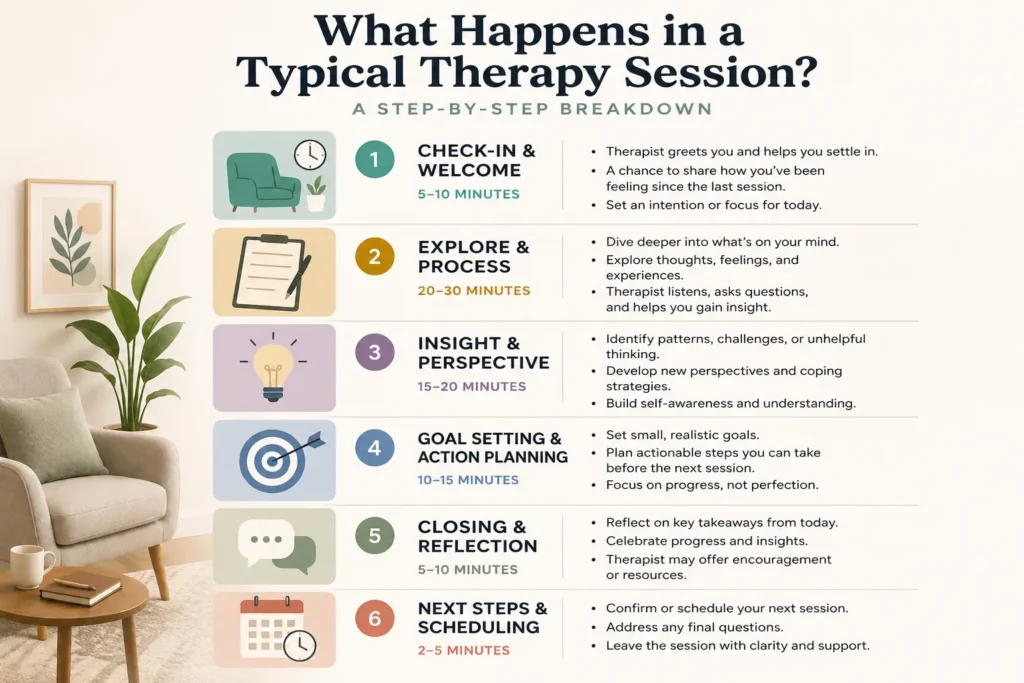
After the initial intake, most individual therapy sessions follow a loose structure:
- A brief check-in on how the past week has gone
- Discussion of specific concerns, patterns, or events
- Exploration using techniques suited to your therapist’s approach (such as cognitive behavioral therapy)
- Identifying coping strategies or insights to carry forward
- Occasionally, a small “homework” reflection or exercise for the week ahead
Did You Know? Cognitive behavioral therapy, one of the most widely used approaches in therapy, is grounded in decades of research showing it can meaningfully reduce symptoms of anxiety and depression.
How Long Does Individual Therapy Take?
There’s no universal timeline therapy can range from a few months of focused, goal-specific work to ongoing, longer-term support. Several factors influence this:
- The nature and complexity of what you’re working through
- How consistently you attend sessions
- Whether therapy is combined with medication management
- Your personal goals symptom relief versus deeper, long-term growth
Expert Advice: Rather than fixating on a specific number of sessions, it can help to check in periodically with your therapist about progress toward your original goals, adjusting the plan as needed.
Myth vs. Fact
Myth: “If therapy isn’t fixing everything after a few sessions, it’s not working.” Fact: Meaningful change in therapy often unfolds gradually. Early sessions are frequently about building trust and understanding patterns before deeper shifts become noticeable.
Myth: “A good therapist will feel like the right fit immediately.” Fact: It’s common to need a session or two to gauge fit, and it’s completely acceptable to switch therapists if the connection doesn’t feel right that doesn’t mean therapy itself has failed.
Individual Therapy vs. Group Therapy
| Feature | Individual Therapy | Group Therapy |
|---|---|---|
| Format | One-on-one with a therapist | Small group with a facilitator |
| Focus | Fully personalized to you | Shared themes among participants |
| Pace | Set entirely by your needs | Balanced across group members |
| Privacy | Fully confidential, one-on-one | Confidential within the group setting |
| Best for | Deep, individualized exploration | Shared experience and peer connection |
Many people benefit from combining both approaches, depending on their goals and circumstances.
What Individual Therapy Can Help With
therapy is a flexible, evidence-based tool for a wide range of concerns, including:
- Anxiety and generalized worry
- Depression and persistent low mood
- Trauma and PTSD-related symptoms
- Relationship and communication difficulties
- Major life transitions or grief
- ADHD-related executive function challenges
- General stress that’s become difficult to manage alone
Warning Sign Box: If you’re experiencing thoughts of self-harm or suicide between sessions, don’t wait for your next appointment. Call or text 988 (Suicide & Crisis Lifeline) or go to the nearest emergency room immediately.
Is Therapy Confidential?
Yes, confidentiality is a foundational part of therapy. What you share stays between you and your therapist, with limited legal exceptions (such as imminent risk of harm to yourself or others). Your therapist will typically walk you through these boundaries during your first session, so you know exactly what to expect.

Can Therapy Be Combined With Medication?
Absolutely. For many conditions, therapy works well alongside medication management, addressing both the biological and psychological sides of mental health. Your therapist and psychiatric provider can coordinate care to make sure both pieces of your treatment plan are working together.
How to Know If Individual Therapy Is Working
Progress in therapy isn’t always dramatic it often shows up in small, cumulative ways:
- Feeling slightly more equipped to handle difficult moments
- Noticing patterns in your thoughts or behavior you hadn’t seen before
- Small shifts in how you respond to stress
- Feeling more comfortable being honest, even about hard things
- A gradual sense of relief or clarity over time
If you’re unsure whether it’s helping, that’s a completely reasonable thing to bring up directly with your therapist.
How A New Hope Psychiatric Services Approaches Therapy
At A New Hope Psychiatric Services, therapy is built around you your pace, your history, and your goals. Our therapists provide a warm, non-judgmental space to work through anxiety, depression, trauma, ADHD-related struggles, and more, whether you’re new to therapy or returning after time away.
We offer:
- Telehealth therapy appointments available throughout Florida
- In-person appointments at our Clermont, Florida office
- Both insurance and self-pay options
- Therapists currently accepting new patients

If you’ve been putting off that first appointment because you’re not sure what to expect, know this: you don’t need to have it all figured out before you start.
Frequently Asked Questions
Your first session typically focuses on gathering background information your current concerns, history, and goals rather than deep emotional work right away.
It involves regular one-on-one sessions with a licensed therapist, using evidence-based techniques to help you understand patterns, build coping skills, and work toward your specific goals.
It varies widely depending on your goals and circumstances, ranging from a few months of focused work to ongoing, longer-term support.
Weekly sessions are common, especially early on, though frequency can adjust over time based on your needs and progress.
Yes, with limited legal exceptions such as imminent risk of harm, everything discussed in individual therapy is confidential.
Individual therapy is one-on-one and fully personalized, while group therapy involves shared sessions with peers facilitated by a therapist.
Yes, telehealth individual therapy is available and can be just as effective as in-person sessions for many people.
It’s normal to need a session or two to assess fit, and switching therapists if needed is a reasonable and common step.
Yes, nervousness before a first session is extremely common and doesn’t mean anything is wrong.
It’s a widely used, evidence-based approach in individual therapy that focuses on identifying and reshaping unhelpful thought patterns and behaviors.
Yes, it’s one of the most well-researched and effective treatments for both anxiety and depression.
Yes, many people benefit from combining therapy with medication management for a more comprehensive treatment approach.
There’s no fixed number it depends on your specific goals, the complexity of what you’re working through, and how you respond to treatment.
That’s completely normal, and your therapist is trained to help guide the conversation and find direction together.
Sometimes. Reflection exercises or small practice tasks between sessions can help reinforce progress, though this varies by therapist and approach.
Progress is often tracked through periodic check-ins on your original goals, along with noticeable shifts in symptoms, coping, and daily functioning.
Many insurance plans cover individual therapy; A New Hope accepts both insurance and self-pay patients.
Yes, trauma-informed individual therapy can help process traumatic experiences and reduce related symptoms over time.
Through a personalized, non-judgmental approach tailored to your specific concerns and goals, available via telehealth throughout Florida or in-person in Clermont.
Yes, our therapists are currently accepting new patients for both telehealth and in-person individual therapy appointments in Clermont, Florida.