

It’s 10 a.m. and you’ve already reread the same email three times. Your task list has twelve items on it, but somehow you’ve spent the last hour reorganizing your desktop folders instead of starting any of them. By 3 p.m., you’re mentally exhausted not from working hard, but from working against your own brain all day. If this sounds familiar, you’re likely seeing firsthand how ADHD affects work and productivity not through laziness or lack of ambition, but through real differences in how the brain manages focus, time, and follow-through.
The Workplace Isn’t Built for the ADHD Brain
Most workplaces are structured around sustained attention, linear task completion, and consistent daily output. That structure works well for many people but it can work directly against how ADHD affects attention and motivation. Open-plan offices, back-to-back meetings, and constant digital notifications create an environment that’s particularly difficult for a brain wired for novelty and stimulation rather than repetition.
This mismatch is often mistaken for a performance problem, when it’s really an environment problem colliding with a neurological one.
How ADHD Affects Focus and Concentration
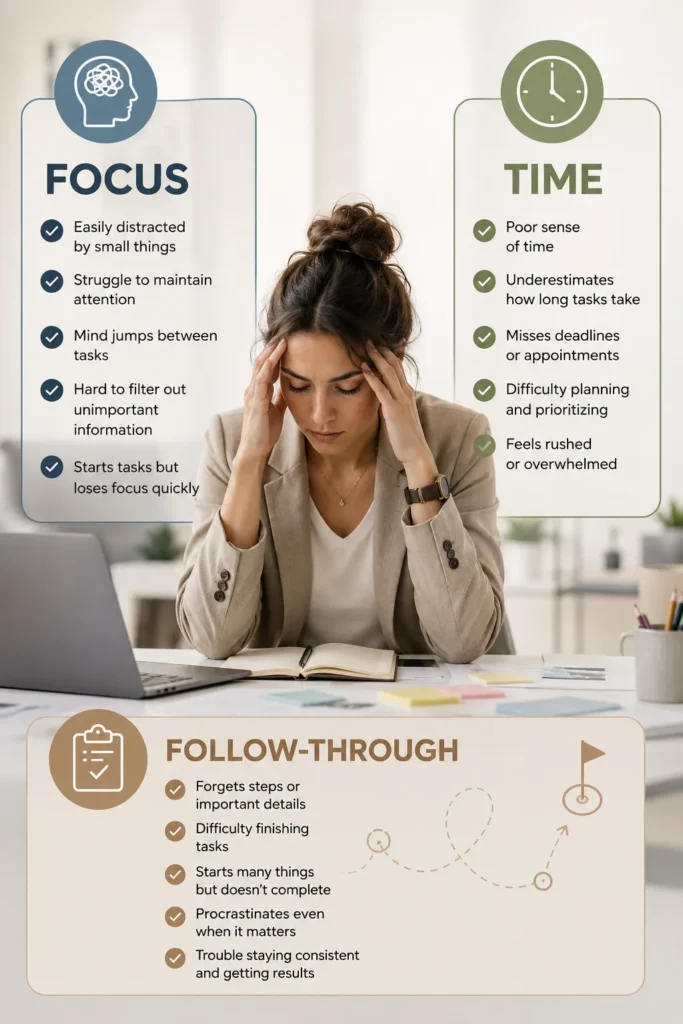
One of the clearest ways ADHD affects the workday is through inconsistent focus. It’s not that people with ADHD can’t concentrate it’s that concentration doesn’t turn on and off by choice.

- Sitting through long meetings can feel like mental endurance training
- Reading dense reports or emails may require rereading the same paragraph several times
- Background noise or visual clutter can pull attention away mid-task
- A single interesting project might absorb hours of hyperfocus, while a routine task gets pushed off for days
Quick Tip: If certain tasks consistently get avoided no matter how important they are, it’s rarely about motivation. It’s often a sign that the task lacks the stimulation an ADHD brain needs to engage.
How ADHD Affects Time Management
Time blindness is one of the most disruptive ways ADHD affects productivity. Many adults with ADHD don’t experience time as a steady, linear progression they experience it in two categories: “now” and “not now.” This makes it genuinely difficult to sense how quickly a deadline is approaching until it’s suddenly urgent.
Common patterns include:
- Underestimating how long tasks will take
- Losing track of time during hyperfocus, missing meetings entirely
- Waiting until the pressure of a deadline to finally start
- Chronic lateness to calls or in-office arrival times
Did You Know? Research on ADHD and executive function suggests that difficulties with time perception are a core, measurable feature of the condition not simply a matter of poor planning habits.
How ADHD Affects Task Prioritization and Follow-Through
Another significant way ADHD affects work is through prioritization. Without a clear internal sense of “what matters most right now,” people with ADHD may:
- Spend hours on a low-priority task while a deadline-critical project sits untouched
- Start several projects with enthusiasm, then lose momentum on all of them
- Feel paralyzed by a long to-do list, unsure where to even begin
- Struggle to break large projects into manageable steps
This isn’t a character flaw it reflects real differences in the brain’s executive function systems, which govern planning, sequencing, and sustained motivation.
How ADHD Affects Communication and Workplace Relationships
ADHD affects more than individual output it shapes how people show up in meetings, emails, and team dynamics. Common workplace patterns include:
- Interrupting colleagues or blurting out ideas mid-conversation
- Missing details in verbal instructions
- Forgetting to follow up on commitments made in meetings
- Feeling easily overwhelmed by rapid-fire messages or notifications
- Sensitivity to feedback, sometimes perceived as defensiveness
Left unaddressed, these patterns can strain relationships with managers and coworkers not because of poor intentions, but because of genuine attention and processing differences.
Myth vs. Fact about ADHD Affects
Myth: “If ADHD really affected your work, you’d get fired so if you’re doing fine, it’s not really a problem.” Fact: Many adults compensate for how ADHD affects their productivity through masking working longer hours, over-preparing, or relying on high-stress deadlines to force focus. This often works for years, until the compensation itself leads to burnout.
Myth: “ADHD only affects people who can’t hold down a job.” Fact: ADHD affects people across every profession and performance level, including high-achieving professionals, executives, and entrepreneurs who’ve built elaborate systems to manage symptoms no one else can see.
ADHD vs. Typical Workplace Stress
| Feature | Typical Workplace Stress | How ADHD Affects Work |
|---|---|---|
| Cause | Specific deadline or workload spike | Ongoing, regardless of workload |
| Focus | Can concentrate once stress resolves | Inconsistent focus even without stress |
| Time perception | Generally accurate | Frequently distorted (time blindness) |
| Task initiation | Delayed but manageable | Often significantly delayed or avoided |
| Recovery | Improves with rest or lighter workload | Persists across projects and roles |
Who Is Most Affected at Work?
While ADHD affects people across every industry, certain patterns are especially common among:
- Remote workers without external structure, executive function challenges often intensify
- Professionals in detail-heavy roles accounting, data entry, or compliance work can be especially draining
- People in fast-paced, meeting-heavy jobs constant task-switching increases cognitive load
- High-achievers who mask well years of compensating can lead to sudden burnout that looks like it came “out of nowhere”
Warning Sign Box: If work-related overwhelm has led to persistent hopelessness, panic, or thoughts of self-harm, this is a medical emergency. Call or text 988 (Suicide & Crisis Lifeline) or go to the nearest emergency room immediately.
How ADHD Affects Long-Term Career Growth
Beyond day-to-day tasks, ADHD affects long-term career trajectory in ways that often go unrecognized:
- Missed promotions due to inconsistent output, despite strong potential
- Frequent job changes driven by burnout rather than skill mismatch
- Difficulty with long-term projects that require sustained, low-stimulation effort
- Underestimating one’s own capabilities due to years of unexplained struggle
Recognizing these patterns as symptoms not personal failures is often the first step toward a completely different career trajectory.
When Should You Seek Help?

Consider a professional evaluation if:
- Work struggles have followed you across multiple jobs or roles
- You’re consistently exhausted from compensating for focus or organization gaps
- Deadlines, meetings, or follow-through feel disproportionately difficult
- Coworkers or managers have noted inconsistency you can’t explain
- Self-help productivity systems haven’t created lasting change
Expert Advice: A thorough psychiatric evaluation looks at how symptoms show up specifically in your work life not just a general checklist to build a treatment plan suited to your actual daily demands.
Treatment That Helps Address How ADHD Affects Work

The encouraging news: how ADHD affects productivity can change significantly with the right treatment. Effective approaches often include:
- Psychiatric evaluation to accurately diagnose ADHD and rule out overlapping conditions
- Medication management stimulant and non-stimulant medications can meaningfully improve focus, follow-through, and time management
- Genetic testing (GeneSight®) helps identify which medications may work best for your body, reducing trial and error
- Individual therapy cognitive behavioral therapy adapted for ADHD can build practical executive function strategies
- Workplace strategies external structure, task breakdowns, and communication tools that reduce daily friction
Quick Tip: Productivity apps and planners can help, but they work best alongside not instead of professional treatment that addresses the underlying neurological patterns.
How A New Hope Psychiatric Services Helps
At A New Hope Psychiatric Services, we understand how draining it is to work twice as hard for the same results as everyone else. Our team provides compassionate, evidence-based care for adolescents and adults across Florida, offering psychiatric evaluations, medication management, and individual therapy tailored to how ADHD affects your specific work and daily life.
We offer:
- Telehealth appointments available throughout Florida
- In-person appointments at our Clermont, Florida office
- Both insurance and self-pay options
- Providers and therapists currently accepting new patients
If ADHD has been quietly shaping your career for years, it’s not too late to get support that actually fits how your brain works.
Frequently Asked Questions
ADHD affects work performance through inconsistent focus, difficulty managing time, trouble prioritizing tasks, and challenges with follow-through, even among capable and motivated employees.
ADHD affects productivity by making it harder to start tasks, sustain attention on non-stimulating work, and accurately estimate how long projects will take.
It can contribute to job instability, particularly when symptoms go unaddressed, though many people with ADHD build successful careers with the right treatment and strategies.
Sustained attention during long or repetitive meetings can be especially difficult, often leading to zoning out or missing key details.
Time blindness, a core symptom of ADHD, makes it difficult to accurately sense how quickly deadlines are approaching or how long tasks will take.
For many people, yes medication can improve focus, impulse control, and follow-through, though it works best combined with practical strategies and therapy.
Without external structure and accountability, executive function challenges often intensify in remote settings, though the right systems can help significantly.
Yes. Inconsistent performance from undiagnosed ADHD can lead to missed promotions or frequent job changes, often misattributed to lack of ambition or skill.
Flexible scheduling, written instructions, reduced open-office noise, and task breakdown tools are common accommodations that support ADHD-related work challenges.
Contrary to assumption, ADHD often makes true multitasking harder, not easier, due to difficulty sustaining attention across multiple demands at once.